
Forum rules
Oekaki posts must follow our Rules for the Site and Forum,
including the Oekaki Rules and Art Rules.
Having trouble using oekaki? Check out the Oekaki Guide or send in a help ticket.
Oekaki posts must follow our Rules for the Site and Forum,
including the Oekaki Rules and Art Rules.
Having trouble using oekaki? Check out the Oekaki Guide or send in a help ticket.
kalon 610 by irina

| Based on | Click to view |
| Artist | irina [gallery] |
| Time spent | 26 minutes |
| Drawing sessions | 1 |
| 21 people like this | Log in to vote for this drawing |

10 posts
• Page 1 of 1
kalon 610
 by irina » Fri Oct 14, 2016 1:36 pm

Kalons-- a species with soft manes and even softer hearts.
(edited tail shine)
Monitored in forests across the globe for years, these animals
have recently been declared naturally tame as well as sentient.
Scientists are asking the general population to consider adopting
Kalons for further study in their capabilities of intelligence.
Feeling a bit blue today, so here's a worried little Kalon!
It's a FCFS, but you need to answer all the questions correctly!
Gonna have a little fun with this hehe, please no tbd on the name and gender!
- Code: Select all
username;
name;
gender;
6 ÷ 2 (1 + 2) = ? [answer is _]
inspirational gif;
funny animal picture;
Halloween costume fail;
Last edited by irina on Fri Oct 14, 2016 1:48 pm, edited 1 time in total.

-

irina - Posts: 6938
- Joined: Tue Jan 21, 2014 11:00 am
- My pets
- My items
- My wishlist
- My gallery
- My scenes
- My dressups
- Trade with me
Re: kalon 610
by credit » Fri Oct 14, 2016 1:39 pm
username;Credit
name;Bello
gender; male
6 ÷ 2 (1 + 2) = [answer is 1]
inspirational gif;
funny animal picture;
Halloween costume fail;
name;Bello
gender; male
6 ÷ 2 (1 + 2) = [answer is 1]
inspirational gif;
funny animal picture;
Halloween costume fail;
Last edited by credit on Fri Oct 14, 2016 1:44 pm, edited 1 time in total.
【Key】
【They/Them || Adult 】
【Cancer ♋︎ Crab 】
【They/Them || Adult 】
【Cancer ♋︎ Crab 】

-

credit - Posts: 7060
- Joined: Tue May 01, 2012 12:31 pm
- My pets
- My items
- My wishlist
- My gallery
- My scenes
- My dressups
- Trade with me
Re: kalon 610
by Ravendarus » Fri Oct 14, 2016 1:41 pm
username; Ravendarus
name; Lillia
gender; Female
6 ÷ 2 (1 + 2) = ? [answer is _] um 6?
inspirational gif; http://data1.whicdn.com/images/24416798/large.gif
funny animal picture; http://www.dumpaday.com/wp-content/uplo ... ove-it.jpg
Halloween costume fail; http://partnerwithsheena.com/wp-content ... ails-5.jpg
name; Lillia
gender; Female
6 ÷ 2 (1 + 2) = ? [answer is _] um 6?
inspirational gif; http://data1.whicdn.com/images/24416798/large.gif
funny animal picture; http://www.dumpaday.com/wp-content/uplo ... ove-it.jpg
Halloween costume fail; http://partnerwithsheena.com/wp-content ... ails-5.jpg
Last edited by Ravendarus on Fri Oct 14, 2016 1:42 pm, edited 1 time in total.


-

Ravendarus - Posts: 66630
- Joined: Tue Jan 06, 2009 12:19 pm
- My pets
- My items
- My wishlist
- My gallery
- My scenes
- My dressups
- Trade with me
Re: kalon 610
by Tricksters » Fri Oct 14, 2016 1:41 pm
username; tricksters
name; jonah
gender; agender
6 ÷ 2 (1 + 2) = 9
inspirational gif;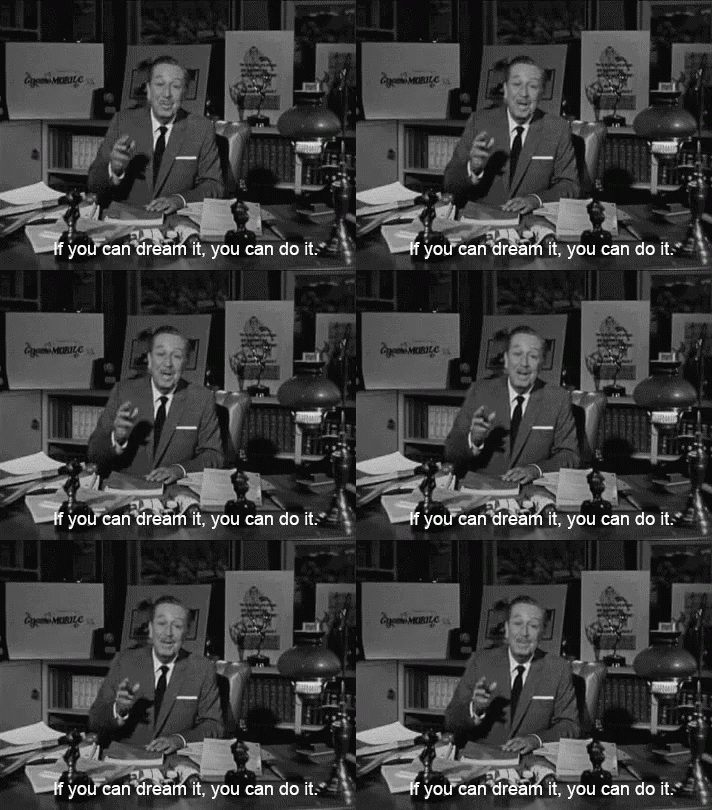
funny animal picture;
Halloween costume fail; http://img.costumemodels.com/1/493/wolv ... e-fail.jpg
name; jonah
gender; agender
6 ÷ 2 (1 + 2) = 9
inspirational gif;
funny animal picture;
Halloween costume fail; http://img.costumemodels.com/1/493/wolv ... e-fail.jpg
Last edited by Tricksters on Fri Oct 14, 2016 1:44 pm, edited 1 time in total.
-

Tricksters - Posts: 31082
- Joined: Wed Apr 04, 2012 9:36 am
- My pets
- My items
- My wishlist
- My gallery
- My scenes
- My dressups
- Trade with me
Re: kalon 610
by wajas » Fri Oct 14, 2016 1:42 pm
username; wajas
name; Thyme
gender; female
6 ÷ 2 (1 + 2) = ? [answer is 9]
inspirational gif;
funny animal picture;
Halloween costume fail;
name; Thyme
gender; female
6 ÷ 2 (1 + 2) = ? [answer is 9]
inspirational gif;
funny animal picture;
Halloween costume fail;




-

wajas - Posts: 40710
- Joined: Thu Jun 30, 2011 9:39 am
- My pets
- My items
- My wishlist
- My gallery
- My scenes
- My dressups
- Trade with me
Re: kalon 610
by Idem » Fri Oct 14, 2016 1:43 pm
username; Idem
name; Blu
gender; Female
6 ÷ 2 (1 + 2) = ? [answer is 6]
inspirational gif; https://giphy.com/gifs/studiosoriginals-domitille-collardey-l41Yh1olOKd1Tgbw4
funny animal picture; http://quotesnhumor.com/wp-content/uploads/2014/12/Funny-Animal-Memes.jpg
Halloween costume fail; http://www.amusingtime.com/images/07/funny-halloween-costume-fail.jpg
name; Blu
gender; Female
6 ÷ 2 (1 + 2) = ? [answer is 6]
inspirational gif; https://giphy.com/gifs/studiosoriginals-domitille-collardey-l41Yh1olOKd1Tgbw4
funny animal picture; http://quotesnhumor.com/wp-content/uploads/2014/12/Funny-Animal-Memes.jpg

Halloween costume fail; http://www.amusingtime.com/images/07/funny-halloween-costume-fail.jpg


Hey, I'm Idem! I'm just another person who enjoys collecting rocks and crystals, drawing, playing D&D, and listening to music (tøp, Porter Robinson, Hozier, half•alive). I'm always open for a PM if you'd like to talk. <3
Rocky Mountain Stables Hub


-Do not go gentle into that good night-
-Rage, rage against the dying of the light.-
-Rage, rage against the dying of the light.-
-

Idem - Posts: 4740
- Joined: Sun Sep 22, 2013 10:22 am
- My pets
- My items
- My wishlist
- My gallery
- My scenes
- My dressups
- Trade with me
Re: kalon 610
by irina » Fri Oct 14, 2016 1:45 pm
Congrats wajas! The answer to the math question is actually 9!
explanation;
Thanks everyone for taking a shot at this, and for cheering me up, you guys had really funny pictures/gifs! <3
explanation;
The handy order of operations rule you learned in grade school, PEMDAS, says you should solve a problem by working through the Parentheses, then the Exponents, the Multiplication and Division, followed by Addition and Subtraction. But the thing about PEMDAS is, some people interpret it different ways and in there lies the controversy behind this problem.
Some people think that anything touching a parentheses should be solved FIRST. Which means they simplify the problem as follows: 6÷2(1+2) = 6÷ 2(3) = 6÷6 = 1.
But just because a number is touching a parentheses doesn't mean it should be multiplied before division that's to the left of it. PEMDAS says to solve anything inside parentheses, then exponents, and then all multiplication and division from left to right in the order both operations appear (that's the key). That means that once you solve everything inside the parenthesis and simplify the exponents, you go from left to right no matter what. That means the problem should actually be solved as follows: 6÷2(1+2) = 6÷2*(1+2) = 6÷2*3 = 3*3 = 9.
Thanks everyone for taking a shot at this, and for cheering me up, you guys had really funny pictures/gifs! <3
-
irina - Posts: 6938
- Joined: Tue Jan 21, 2014 11:00 am
- My pets
- My items
- My wishlist
- My gallery
- My scenes
- My dressups
- Trade with me
Re: kalon 610
by credit » Fri Oct 14, 2016 1:46 pm
congrats
School has messed up my ability to math XD
School has messed up my ability to math XD
Last edited by credit on Fri Oct 14, 2016 1:50 pm, edited 1 time in total.
-
credit - Posts: 7060
- Joined: Tue May 01, 2012 12:31 pm
- My pets
- My items
- My wishlist
- My gallery
- My scenes
- My dressups
- Trade with me
Re: kalon 610
by wajas » Fri Oct 14, 2016 1:47 pm
Ahhh, thank you! ;;V;; I was afraid my answer was wrong. XD Thanks for posting the FCFS! She's so pretty~!
-
wajas - Posts: 40710
- Joined: Thu Jun 30, 2011 9:39 am
- My pets
- My items
- My wishlist
- My gallery
- My scenes
- My dressups
- Trade with me
Re: kalon 610
by Ravendarus » Fri Oct 14, 2016 1:49 pm
XD I was right the first time ahhh oh well! Eeep congrats wajas!
-
Ravendarus - Posts: 66630
- Joined: Tue Jan 06, 2009 12:19 pm
- My pets
- My items
- My wishlist
- My gallery
- My scenes
- My dressups
- Trade with me
10 posts
• Page 1 of 1
Who is online
Users browsing this forum: werepickle and 2 guests