
Forum rules
Oekaki posts must follow our Rules for the Site and Forum,
including the Oekaki Rules and Art Rules.
Having trouble using oekaki? Check out the Oekaki Guide or send in a help ticket.
Oekaki posts must follow our Rules for the Site and Forum,
including the Oekaki Rules and Art Rules.
Having trouble using oekaki? Check out the Oekaki Guide or send in a help ticket.
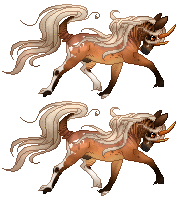
Maple Island Pony Adopts by The Royal Mirage

| Artist | The Royal Mirage [gallery] |
| Time spent | 12 hours, 22 minutes |
| Drawing sessions | 13 |
| 63 people like this | Log in to vote for this drawing |


Maple Island Pony Adopts
 by The Royal Mirage » Fri Nov 21, 2014 9:28 am
Genetics - Fanclub - Artist Search - Archives
Maple Island Ponies (equus cornutus) are a subspecies of equine found on the 70 000 square kilometre expanse of the Maple Islands. The ponies have been largely isolated from humans and other equines for hundreds of thousands of years, and as such have adapted to suit their specific environment.
Physical Features
The ponies are generally small, measuring around 10-12.2hh most of the time, though some individuals can be as small as 9hh or as tall as 14.3hh at the withers. They have small, tough hooves with a small amount of feathering, short legs and somewhat pudgy bodies. Males tend to display brighter colouration and flashier patterns, and have longer hairs over the chest, whereas mares tend to have sleeker coats with more neutral colouring. The manes and tails of females can grow quite a bit longer than those on males, which tend to be shorter and mostly upright. Many are very sure-footed, and have excellent stamina and agility. A most peculiar trait, and the species greatest identifier, are the horns that have developed on their heads. Maple Island Ponies have developed horns which usually grow from just behind the ears, though some are formed elsewhere on the skull, many of which mimic horns of other species. It is extremely rare to find a Maple Island Pony without horns, though it is possible. Maple Island Ponies are very long-lived, and can live up to their mid-thirties even in the wild; in captivity, some have been known to survive and even breed into their forties.
Maple Island Ponies (equus cornutus) are a subspecies of equine found on the 70 000 square kilometre expanse of the Maple Islands. The ponies have been largely isolated from humans and other equines for hundreds of thousands of years, and as such have adapted to suit their specific environment.
Physical Features
The ponies are generally small, measuring around 10-12.2hh most of the time, though some individuals can be as small as 9hh or as tall as 14.3hh at the withers. They have small, tough hooves with a small amount of feathering, short legs and somewhat pudgy bodies. Males tend to display brighter colouration and flashier patterns, and have longer hairs over the chest, whereas mares tend to have sleeker coats with more neutral colouring. The manes and tails of females can grow quite a bit longer than those on males, which tend to be shorter and mostly upright. Many are very sure-footed, and have excellent stamina and agility. A most peculiar trait, and the species greatest identifier, are the horns that have developed on their heads. Maple Island Ponies have developed horns which usually grow from just behind the ears, though some are formed elsewhere on the skull, many of which mimic horns of other species. It is extremely rare to find a Maple Island Pony without horns, though it is possible. Maple Island Ponies are very long-lived, and can live up to their mid-thirties even in the wild; in captivity, some have been known to survive and even breed into their forties.
Note: As an owner, if at any point you would like a copy of your pony with a transparent background, just contact me and ask

General Rules:
~Do not claim species as your own, make sure to link back to this post if you post pictures of them off site
~Do not claim a design that does not belong to you
~Do not remove my signature
~Be kind and respectful – if you have an issue with someone, pm myself or a mod to have it resolved
~Unless you are an official artist, do not create your own Maple Island Ponies
Adoption and Breeding Rules:
~You can adopt as many as you like
~You can try to adopt as many as you like at once, but will only be able to win one pony per week.
~Any MIP without an 'Adopt Me' sticker at the top is not available for adoption
~The adoption method will be specified for each individual
~You may not give away or sell a MIP once you have it – there will be opportunities to re-adopt MIPs if you no longer wish to own yours
~MIPs are able to breed 10 times
~Twins are extremely rare, but not totally impossible
~The person who pays for the breeding gets the foal
Staff:
The Royal Mirage (creator, mod, original artist, breeding artist, head honcho)
mikune (official archivist and cow overlord)
Dia. (original artist as of June 12)
Staff Positions:
- original artists – will be looking, requires basic genetics knowledge
- guest artists – will be looking, requires basic genetics knowledge
- breeding artists – will be looking, requires knowledge of genetic inheritance
- moderators – will be looking
Blacklist:
No one! Let's try to keep it that way
Stamps:
We have one! Put it in your signature if you'd like to show your support

- Code: Select all
[url=http://www.chickensmoothie.com/Forum/viewtopic.php?f=52&t=2523116][img]http://fc09.deviantart.net/fs70/f/2014/346/8/f/new_stamp_by_alicemaple-d89naxe.png[/img][/url]
Affiliates:
Stoney Ridge Feliquids
Redwood Valley Equestrian Centre





Last edited by The Royal Mirage on Thu Jan 14, 2016 5:00 pm, edited 23 times in total.

-

The Royal Mirage - Posts: 20972
- Joined: Sat Jun 12, 2010 12:19 pm
- My pets
- My items
- My wishlist
- My gallery
- My scenes
- My dressups
- Trade with me
Additional Information
by The Royal Mirage » Fri Nov 21, 2014 9:29 am
Diet
The Maple Islands consist mostly of forests and grassland, and as such Maple Island Ponies have adapted their diet to fit the environment. In their natural habitat, they will eat mostly grass, leaves from deciduous trees, seaweed, and moss or lichen. They are able to consume bark and twigs in the winter, when the cold takes away much of their usual diet, however this leaves room for one of their favourite native treats – maple sap. When domesticated, the ponies can eat hay, oats and barley, turnips, beets, carrots, corn, apples and bananas. A special treat would be maple sugar products – maple syrup, maple candies, maple sugar, etc. They can consume other sweet products, such as honey or sugar from sugar cane/sugar beets, but don't seem to like these as much.
Predators and Environmental Conditions
The islands are often ravaged by severe rainstorms and harsh winds; in winter, the snow can fall up to 5 feet deep on the islands' north face. Summers are balmy and hot, with minimal rainfall after the wet season of winter-spring has passed; the relentless heat and driving sea winds are the cause of harsh electrical storms which sometimes take place in summer. Some ponies have been known to perish from being struck by lightning during such storms, while forests have been wholly burned down after harsher storms – most ponies know to stick to the flat lowlands when such storms occur, and have even been known to swim for hours waiting for a forest fire to burn itself out. Predators of the Maple Island Ponies include leopards, which are well suited to the hot island summers and harsh winters, wolves, and cougars. Wolves will generally hunt in packs and go after the weak or sick adults, whereas foals and elderly are the targets of the lone-hunting leopards and cougars. Bears live on the islands as well, but have not been known to hunt the ponies – instead, they will scavenge the carcasses of those already dead from weather, illness, old age, or previous hunters.
Human Use
Once domesticated, Maple Island Ponies can be ridden by children and occasionally small adults in most disciplines, though ones that are taken directly from the wild can be a bit of a handful. They make excellent driving ponies that can pull loads greater than their own weight, and work especially well in teams of 2 or more. Many make good mounted games ponies, and others may excel in low-level jumping, cross country, and dressage.
Colour Frequencies
While they can display all regular horse colours, and more, Maple Island Ponies are most often shades of dun or roan, with mealy or pangare being very common. Other common colours include bay, black, chestnut, gray, with common modifiers being sooty, flaxen, tobiano, and sabino. Less common colours include cream gene colours (palomino, buckskin, smoky black, cremello, perlino, and smoky cream), pearl and champagne genes, overo, appaloosa, silver, rabicano, and dominant white.
The Maple Islands consist mostly of forests and grassland, and as such Maple Island Ponies have adapted their diet to fit the environment. In their natural habitat, they will eat mostly grass, leaves from deciduous trees, seaweed, and moss or lichen. They are able to consume bark and twigs in the winter, when the cold takes away much of their usual diet, however this leaves room for one of their favourite native treats – maple sap. When domesticated, the ponies can eat hay, oats and barley, turnips, beets, carrots, corn, apples and bananas. A special treat would be maple sugar products – maple syrup, maple candies, maple sugar, etc. They can consume other sweet products, such as honey or sugar from sugar cane/sugar beets, but don't seem to like these as much.
Predators and Environmental Conditions
The islands are often ravaged by severe rainstorms and harsh winds; in winter, the snow can fall up to 5 feet deep on the islands' north face. Summers are balmy and hot, with minimal rainfall after the wet season of winter-spring has passed; the relentless heat and driving sea winds are the cause of harsh electrical storms which sometimes take place in summer. Some ponies have been known to perish from being struck by lightning during such storms, while forests have been wholly burned down after harsher storms – most ponies know to stick to the flat lowlands when such storms occur, and have even been known to swim for hours waiting for a forest fire to burn itself out. Predators of the Maple Island Ponies include leopards, which are well suited to the hot island summers and harsh winters, wolves, and cougars. Wolves will generally hunt in packs and go after the weak or sick adults, whereas foals and elderly are the targets of the lone-hunting leopards and cougars. Bears live on the islands as well, but have not been known to hunt the ponies – instead, they will scavenge the carcasses of those already dead from weather, illness, old age, or previous hunters.
Human Use
Once domesticated, Maple Island Ponies can be ridden by children and occasionally small adults in most disciplines, though ones that are taken directly from the wild can be a bit of a handful. They make excellent driving ponies that can pull loads greater than their own weight, and work especially well in teams of 2 or more. Many make good mounted games ponies, and others may excel in low-level jumping, cross country, and dressage.
Colour Frequencies
While they can display all regular horse colours, and more, Maple Island Ponies are most often shades of dun or roan, with mealy or pangare being very common. Other common colours include bay, black, chestnut, gray, with common modifiers being sooty, flaxen, tobiano, and sabino. Less common colours include cream gene colours (palomino, buckskin, smoky black, cremello, perlino, and smoky cream), pearl and champagne genes, overo, appaloosa, silver, rabicano, and dominant white.
-
The Royal Mirage - Posts: 20972
- Joined: Sat Jun 12, 2010 12:19 pm
- My pets
- My items
- My wishlist
- My gallery
- My scenes
- My dressups
- Trade with me
Re: Maple Island Pony Adopts
by The Royal Mirage » Fri Nov 21, 2014 3:13 pm
Posting is now open, will be making some ponies to adopt~
-
The Royal Mirage - Posts: 20972
- Joined: Sat Jun 12, 2010 12:19 pm
- My pets
- My items
- My wishlist
- My gallery
- My scenes
- My dressups
- Trade with me
Re: Maple Island Pony Adopts
by Poison Wolf » Fri Nov 21, 2014 3:17 pm
Marking~ ovo
These seem very cute and yet very complex cx
These seem very cute and yet very complex cx
Important Links:
My fiance <3
DeviantArt
Tumblr
Character Site [Major wip]

Check out these species:
Rukami
Deerssert
Hooded Dragons
L.O.C.
Current Mood:
My fiance <3
murr crimis
DeviantArt
Tumblr
Character Site [Major wip]
Check out these species:
Rukami
Deerssert
Hooded Dragons
L.O.C.
I always have commissions open here.
-

Poison Wolf - Posts: 10139
- Joined: Thu Jul 29, 2010 6:43 am
- My pets
- My items
- My wishlist
- My gallery
- My scenes
- My dressups
- Trade with me
Re: Maple Island Pony Adopts
by The Royal Mirage » Fri Nov 21, 2014 3:49 pm
Thank you ^^ First pony is up, will be making one more for tonight
-
The Royal Mirage - Posts: 20972
- Joined: Sat Jun 12, 2010 12:19 pm
- My pets
- My items
- My wishlist
- My gallery
- My scenes
- My dressups
- Trade with me
-

Azteca. - Posts: 2214
- Joined: Sat Jul 19, 2014 6:28 am
- My pets
- My items
- My wishlist
- My gallery
- My scenes
- My dressups
- Trade with me
Re: Maple Island Pony Adopts
by The Royal Mirage » Fri Nov 21, 2014 5:11 pm
Second pony is up, a stallion this time ^^ And now I must sleep, there will definitely be more to come soon.
-
The Royal Mirage - Posts: 20972
- Joined: Sat Jun 12, 2010 12:19 pm
- My pets
- My items
- My wishlist
- My gallery
- My scenes
- My dressups
- Trade with me


-

SmileChild - Posts: 5948
- Joined: Mon Jul 02, 2012 3:52 am
- My pets
- My items
- My wishlist
- My gallery
- My scenes
- My dressups
- Trade with me
Re: Maple Island Pony Adopts
by The Royal Mirage » Sat Nov 22, 2014 7:09 am
New mare up for adoption! She is first come first served!
-
The Royal Mirage - Posts: 20972
- Joined: Sat Jun 12, 2010 12:19 pm
- My pets
- My items
- My wishlist
- My gallery
- My scenes
- My dressups
- Trade with me
- horrorterror
- Posts: 22315
- Joined: Tue Sep 23, 2008 10:11 am
- My pets
- My items
- My wishlist
- My gallery
- My scenes
- My dressups
- Trade with me
Who is online
Users browsing this forum: Yandex and 2 guests