
August 2021 Discussion Thread
Re: August 2021 Discussion Thread
 by EmberWolf » Tue Aug 31, 2021 9:37 pm
Since all of them are revealed I'll explain the whole draft litter :)
Genetic key:
E = black (can produce black pigment)
e = red (can't produce black pigment)
Black (E) is dominant, so just ee will produce only red pigment
A = agouti, or bay, restricts black pigment to points. Only shows on horses with at least one E for the black points; if there is no black pigment, there is nothing to restrict, so ee (red) horses do not look any different no matter their agouti status
Agouti is dominant, so Aa = bay also, if at least one E is present
aa = not bay, does not restrict black pigment if present (E_/aa is the only way to get a black horse)
Any letter with a _ next to it, such as A_, means it has at least one dominant gene present and the other can test either or and not affect the color. For example, E_/A_ will always be bay, whether it tests EE/AA, Ee/AA, EE/Aa, or Ee/Aa
Each base color is used for the foals: red, black, and bay, all + roan. Yes, bay is considered a base color! It was the original color before just red or black existed, all original early wild horses were EE/AA/DD (bay dun). Only later were there red and black horses.
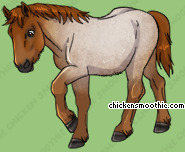
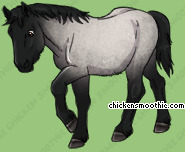
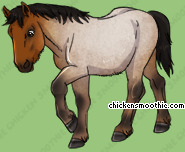
The first split adult outcomes revealed of each were simply the base + roan, and possibly plus a pattern.
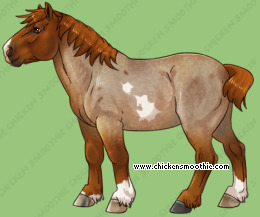 - Red roan frame
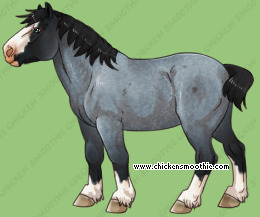 - Black roan splash
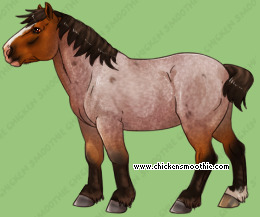 - Bay roan solid
The other splits were meant to be sort of twists on the first ones.
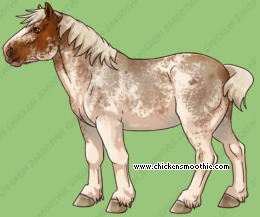 - Red roan sabino. This is not roan, but a roan-like look from a sabino pattern. Extensive sabino patterns (which come from a variety of genes, some untestable, meaning we do not know the gene it comes from) can cause roan-like white ticking throughout the coat, but are caused by the pattern and not a roan gene. This is especially common in drafts like Clydesdales, where there is an untestable white spotting (a.k.a. sabino) pattern that looks roan-like.
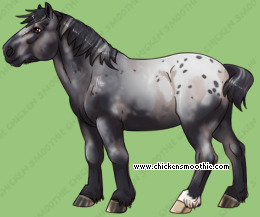 - Black varnish, a.k.a. varnish roan. Again, this is not caused by the same roan gene but is instead caused by LP, or the appaloosa gene. It can also give a roan-like appearance but the white ticking can be a lot more wide-spread and pigmented areas can be different.
Plus, spots! Roan can have "corn spotting," which I added to every true roan outcome, but corn spotting is not an actual pattern or gene. It is caused when the horse gets a knick or cut or other injuries to the hide. The hair will grow back completely pigmented and without the white ticking. On the black varnish, however, the spots are caused by the appaloosa pattern, which is why they are in a more typical appaloosa formation rather than randomly scattered and shaped.
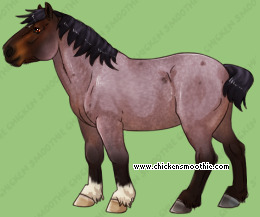 - Seal brown roan. Genetically, this is the same as a bay roan, just darker. There was the belief that a modification to agouti was found and that seal brown could be tested, but it isn't true. Seal browns will test exactly genetically the same as a regular bay (E_/A_). Though it is considered true that, more often than not, seal browns test EE/A_. Still, seal brown is only a phenotype. Seal brown roans can often give the appearance of being black roans. The only way to truly tell for dark seal browns, most of the time, is the "cinnamon" muzzle. I did give this one a bit more of a bay/purplish hue rather than the very close to black roan look many can have.
So there you have it! Roans with a twist. Maybe some of you found this informaton interesting :)
Genetic key:
E = black (can produce black pigment)
e = red (can't produce black pigment)
Black (E) is dominant, so just ee will produce only red pigment
A = agouti, or bay, restricts black pigment to points. Only shows on horses with at least one E for the black points; if there is no black pigment, there is nothing to restrict, so ee (red) horses do not look any different no matter their agouti status
Agouti is dominant, so Aa = bay also, if at least one E is present
aa = not bay, does not restrict black pigment if present (E_/aa is the only way to get a black horse)
Any letter with a _ next to it, such as A_, means it has at least one dominant gene present and the other can test either or and not affect the color. For example, E_/A_ will always be bay, whether it tests EE/AA, Ee/AA, EE/Aa, or Ee/Aa
Each base color is used for the foals: red, black, and bay, all + roan. Yes, bay is considered a base color! It was the original color before just red or black existed, all original early wild horses were EE/AA/DD (bay dun). Only later were there red and black horses.
The first split adult outcomes revealed of each were simply the base + roan, and possibly plus a pattern.
The other splits were meant to be sort of twists on the first ones.
Plus, spots! Roan can have "corn spotting," which I added to every true roan outcome, but corn spotting is not an actual pattern or gene. It is caused when the horse gets a knick or cut or other injuries to the hide. The hair will grow back completely pigmented and without the white ticking. On the black varnish, however, the spots are caused by the appaloosa pattern, which is why they are in a more typical appaloosa formation rather than randomly scattered and shaped.
So there you have it! Roans with a twist. Maybe some of you found this informaton interesting :)

♥ G.B. ♥
rest in peace, special boy
there'll never be another one like you
and my heart will always be missing
your presence from now until always

♥ Rosie ♥
"hey, i'm Ember's cat, Rosie.
if you're wondering, Ember's PM's are always
open if you have other questions or
just want to chat. she does not
take commissions anymore."
she/her | adult | full-time artist

♥ Koda ♥
♥ Koda ♥
"hello I'm Koda, Ember's RL puppy dog. just so you know, she is always looking for missed monthlies on her wishlist."
-

EmberWolf - Posts: 11002
- Joined: Sun Nov 23, 2008 5:20 pm
- My pets
- My items
- My wishlist
- My gallery
- My scenes
- My dressups
- Trade with me
Re: August 2021 Discussion Thread
by Devik » Tue Aug 31, 2021 10:15 pm
Thank you so much, EmberWolf!  Thanks to you I have now a little more understanding of the black magic called horse coat genetics!
Thanks to you I have now a little more understanding of the black magic called horse coat genetics! -

Devik - Posts: 1099
- Joined: Sun Mar 21, 2010 8:39 am
- My pets
- My items
- My wishlist
- My gallery
- My scenes
- My dressups
- Trade with me
Re: August 2021 Discussion Thread
by Aurora Storm » Tue Aug 31, 2021 10:44 pm

I'm always a sucker for realistic equine litters so I'm loving these guys!
The genetic research behind them is just awesome too ♡


-

Aurora Storm - General Helper
- Posts: 17528
- Joined: Sat Sep 05, 2009 10:33 pm
- My pets
- My items
- My wishlist
- My gallery
- My scenes
- My dressups
- Trade with me
Re: August 2021 Discussion Thread
by Luinwen » Tue Aug 31, 2021 10:57 pm
Thank you! That was very interesting. My foals are still growing up, but I only have a black foal and only one left for the red line, so I will miss at least two outcomes. I am very curious which one I will get. I hope for the Black varnish and the Red Roan.
-

Luinwen - Posts: 407
- Joined: Fri Aug 20, 2021 12:44 am
- My pets
- My items
- My wishlist
- My gallery
- My scenes
- My dressups
- Trade with me
Re: August 2021 Discussion Thread
by Magpi3.14 » Wed Sep 01, 2021 2:27 am
EmberWolf wrote:So there you have it! Roans with a twist. Maybe some of you found this information interesting
This whole litter was so cool! I really loved that you explained to us the genetics behind them, its interesting for sure! <3






















-
Magpi3.14 - Posts: 2749
- Joined: Sun Jul 17, 2011 12:04 pm
- My pets
- My items
- My wishlist
- My gallery
- My scenes
- My dressups
- Trade with me
Re: August 2021 Discussion Thread
by GreatWhiteDragon_1 » Wed Sep 01, 2021 5:19 am
I'm not crazy about Rabs, Sabs, Duns nor Roans, but this Sabino pattern I like. 
Could the artist please confirm? I'm pretty sure I'm spot-on with the colour of the koi; just want to be sure.
Windi_1 wrote:Windi_1 wrote:Windi_1 wrote:Koi fanatic here...
Kohaku......
Taisho Sanshoku or Tancho Kohaku......
Shusui......
Tancho......
Chagoi or Ogon......
Hi Utsuri......
Kikukoryu or Utsurimono......
Asagi......
Matsuba......
This is it so far. If anyone has any that are still growing, let me know.
Really want to see how the Asagi and the Matsuba look. I'm kind of disappointed that the Doitsu didn't make it in.
 ...
...
 ...
...
 ...
...
 ...
...
 ...
...
 ...
...
 ...
...
 ...
...
 ...
...
Could the artist please confirm? I'm pretty sure I'm spot-on with the colour of the koi; just want to be sure.
Last edited by Aaron✦ on Wed Sep 01, 2021 11:31 am, edited 1 time in total.
Reason: Please use the edit function rather than double posting.
Reason: Please use the edit function rather than double posting.















-

GreatWhiteDragon_1 - Posts: 10468
- Joined: Wed Oct 15, 2008 9:02 am
- My pets
- My items
- My wishlist
- My gallery
- My scenes
- My dressups
- Trade with me
Re: August 2021 Discussion Thread
by Nikei » Wed Sep 01, 2021 8:50 am
We got all these dogs but not any doberman's. Yeah you can say the new one is a doberman but I don't like the non traditional dobermans. I like the pointed ears and no tail. Also the one staff pet. But can we please get a doberman  . A store doberman would be amazing.
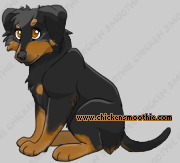
. A store doberman would be amazing.




















-
Nikei - Posts: 14868
- Joined: Mon Dec 21, 2015 3:03 pm
- My pets
- My items
- My wishlist
- My gallery
- My scenes
- My dressups
- Trade with me
Re: August 2021 Discussion Thread
by DeadCellist » Wed Sep 01, 2021 11:24 am
Lucinoxe wrote:Cellist wrote:I really really love the rat pets from the past few months!! I usually don't care much for them, but recently? I LOVE THEM SO MUCH. Especially the ones from July and May! The ones from this month are some of my favorite rats ever tbh <3
The first one goes really well with the leaf designs in your signature!
You're totally right!! I added it to my signature now-- I just had to.
Thank you artists for this awesome month! The realistic horses turned out really beautiful
│
│
✦
│
✦

✧─────────────────✧
Ty | Real Life Dinosaur
Status: Painfully coding
on my phone
✧─────────────────✧
Ty | Real Life Dinosaur
Status: Painfully coding
on my phone
✧─────────────────✧
..
✦
│
│
│
│
-

DeadCellist - Posts: 2288
- Joined: Sun Mar 24, 2013 2:31 pm
- My pets
- My items
- My wishlist
- My gallery
- My scenes
- My dressups
- Trade with me
Re: August 2021 Discussion Thread
by draculauraaa » Wed Sep 01, 2021 11:27 am
I loved all the cats from the international cat day but this baby holds a special place in my heart <3
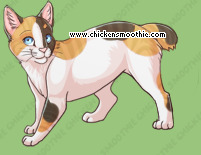
so cute~ <3
so cute~ <3
xxx

𝒽𝑒𝓁𝓁𝑜 𝒹𝒶𝓇𝓁𝒾𝓃𝑔,
┏▰▰▰▰▰▰▰▰▰▰▰▰▰▰▰▰▰▰┓
│
│
│
│
│
│
│
┖▰▰▰▰▰▰▰▰▰▰▰▰▰▰▰▰▰▰┚
┏▰▰▰▰▰▰▰▰▰▰▰▰▰▰▰▰▰▰┓
│
│
│
│
│
│
│
│
│
│
│
│
│
│
│
.
-------⊱♥⊱╮ღ꧁❤꧂ღ╭⊱♥≺
estella | any prounouns!
│-------⊱♥⊱╮ღ꧁❤꧂ღ╭⊱♥≺
estella | any prounouns!
- player since september 2017 ✿
- huge kpop fan ♡ (viviz, twice, yves, nwjns,
nmixx, etc.) ✿
- just on here occasionally <3 ✿
│
│
│
│
│
│
│
┖▰▰▰▰▰▰▰▰▰▰▰▰▰▰▰▰▰▰┚
𝓈𝒾𝓃𝒸𝑒𝓇𝑒𝓁𝓎 𝓎𝑜𝓊𝓇𝓈,
-

draculauraaa - Posts: 1892
- Joined: Sun Sep 24, 2017 5:04 pm
- My pets
- My items
- My wishlist
- My gallery
- My scenes
- My dressups
- Trade with me
Re: August 2021 Discussion Thread
by Nucleoid » Wed Sep 01, 2021 11:28 am
I think this has to be my favorite outcome this month

It reminds me of the 2015 staff litter which I have a big soft spot for ^^


It reminds me of the 2015 staff litter which I have a big soft spot for ^^
Howdy! My name is Toby :3
I am a Marine Biology student
and a Kyojuro Rengoku megafan


Member of CSDS & LTCS
Want someone to talk to about
aquatic creatures?? Feel free to
send me a pm! I absolutely love
a good fun fact!
I am a Marine Biology student
and a Kyojuro Rengoku megafan
Member of CSDS & LTCS
Want someone to talk to about
aquatic creatures?? Feel free to
send me a pm! I absolutely love
a good fun fact!

-

Nucleoid - Posts: 333
- Joined: Tue Jun 23, 2015 9:25 am
- My pets
- My items
- My wishlist
- My gallery
- My scenes
- My dressups
- Trade with me