
Create A Starship Crew V.2
7 posts
• Page 1 of 1
Create A Starship Crew V.2
 by miss universe » Tue Jul 18, 2017 12:00 pm

It's been a few decades since Earth mastered space travel. The universe is far more expansive than anyone could've imagined, and humans are not alone! There are so many different species and planets, and it's your job to explore them all! Will you be able to be one of the best crews out there, or will you choke under the pressure? The choice is yours!

Create a Starship Crew Fanclub V.1
Create a Clan V.3
Create A Clan Fanclub
Create A Clan Roleplay Thread
Create A Pride V.1
Create A Herd V.1
RULES
1) Follow all the Chickensmoothie rules.
2) Do not under any circumstances try to copy
or make a game like this. Message Katrione for permission!
3) I will remake this game at 900 pages.
4) Please use proper grammar and punctuation
and do not use text talk at all.
5) Be kind and respectful to both me and other
members at all times.
6) Do not requote your post unless it has been
skipped over by a mod. It gets annoying and clutters
the thread.
7) Do not Mini Mod unless you are the co-owner or mod
8) Please PM me if you are confused or if you
have any questions.
9) No begging for new crew members/allies/enemies
10) Make sure to have fun! c:
1) Follow all the Chickensmoothie rules.
2) Do not under any circumstances try to copy
or make a game like this. Message Katrione for permission!
3) I will remake this game at 900 pages.
4) Please use proper grammar and punctuation
and do not use text talk at all.
5) Be kind and respectful to both me and other
members at all times.
6) Do not requote your post unless it has been
skipped over by a mod. It gets annoying and clutters
the thread.
7) Do not Mini Mod unless you are the co-owner or mod
8) Please PM me if you are confused or if you
have any questions.
9) No begging for new crew members/allies/enemies
10) Make sure to have fun! c:
- The Federation
Captain: [ Owner ]
miss universe
First Officer: [ Co-Owners ]
.mochi
Chief Medical Officers: [ Mods ]
none as of right now!
Ensigns: [ Mini-Mod ]
- The Unknown
Outlaws: [ Banned ]
None so far, let's hope it stays this way
Username | Ban Length
Username | Ban Length
Username | Ban Length
Username | Ban Length
Username | Ban Length
Criminals: [ Warnings ]
None so far, let's hope it stays this way
Username | Warning No.
Username | Warning No.
Username | Warning No.
Username | Warning No.
HOW TO PLAY
Starting Off
If it is your first time posting, you must tell me about your captain. You can describe things like your captain's name, nature, reputation, and personality. These things help us decide on what your captain will look like! We will quote your post with a picture of your captain and they will be the member who is the leader of your crew. You can decide on things like the captains name, age and gender.
Getting More Crew Members
Your crew will start off small and you will have to build up it's population. You have two options for finding crew-members: exploring and sending your captain to talk to the Federation. You are only able to send your captain to speak to the Federation once every three days, and they can ask them for a new crew-member; you can ask for a specific ranked crew-member or we will give you one at random. You will be able to pick their name, gender and age as well.
Exploring
You are able to send up to 6 crew-members out on an exploring party at a time. There are only a few things that can happen on explorations: you can find crew-members which will keep your crew safe from any attacks for 12 hours; you can encounter a threat, which you can choose to try to engage in battle or ignore, you can find a new crew-member while exploring (however the further along your crew gets the less likely this is to happen), you will usually only find security, engineering and ensigns but you can find a captain of a rival starship that will ask for an alliance that you can accept, ignore or even decide on becoming enemies.
New Ranks
Whenever you have a crew-member that wants to change their rank, you can send your captain to speak to the Federation to tell them of your decision to do a ceremony. If you want a specific rank for your ensign when they are finished training, you will need to include that in the post or I will choose one for you. You must also do this when promoting a crew member to first officer.
Marriage/Having Kids
Without children, your crew would struggle to thrive. To have two characters get married, post them going for a walk together and one of them asking the other to be their husband/wife. In your repliers post, they will time skip to the female finding out she's expecting then you will have to wait two more posts for the child to be born. If you wish for the woman to not have her child yet, make sure to tell me. If you want a member to have another child, say so in your post as well.
And before you ask, YES LGBT+ pairings are permitted here. You can have two dudes get married, same with two girls. If they do this, they can look to adopt, or find another hero willing to carry their child/donate sperm - simply state who the donor/host is, and I'll include that in the reply.
Aging/Death
You must age your crew up 1 month every post that you post. If in one post, you had an crew-member who was 17 years old and 11 months, then in the next post you would make that member be 18 years old. In this game, there are 3 possible ways for your crew to die; old age, being attacked severally by a dangerous alien, and not having your injuries treated within 2 days of them getting injured and/or sick.
Healing
When you find your chief medical officer, you will obtain 5 medicines to start off your medical storage. When you send your chief medical officer out to find medicine, you can only find 2 every exploration the CMO takes to find medicine. Once your medicine cat gets nurses, you will be able to find 3 on one exploration. You store your medicine in the medicine store and they can be used to heal sick or injured crew-members.
Ensigns and Training
You will be the one to assign a certain mentor to a certain ensign. Before your ensign is allowed to become a full crew-member, they must complete 4 training sessions and they must be at least 17 years old. Your ensign learns a new branch during each training session.
Ally Ships
If you meet a strange ship while on an exploration mission, you can choose to become their ally. Ally ships usually act friendly towards each other and resolve disputes without fighting. You can give medicines to an ally ship if they don't have enough medicines they need if they are in desperate need of one. You can also trade crew-members with an ally ship, but this can only happen at a Federation Meeting. If your ship is under attack by an enemy ship, your ally can join the fight and defend you as long as the enemy ship isn't their ally. If your ally defends you in an attack, you have a much less chance of your crew-members dying or being captured.
Enemy Ships
If you meet a strange ship while on an exploration mission, you can choose to become their enemy or rival. Enemy ships usually act hostile towards each other and often argue and fight. You can capture crew-members and medicine while raiding enemy starships. You need 4 crew-members to do this and the only way the ship can get these back is if they attack the offending ship. Attacks can prove fatal and there will often be crew-members injured, captured or even killed during attacks. You can make peace and become allies with an enemy ship during a Federation Meeting.
Federation Meetings
Next Meeting: tba
Meetings happen once every 2 weeks, usually on Saturdays (Some days are put earlier/later because of holidays). At a Meeting, you can choose your Captain, first officer and chief medical officer along with six others to attend and your captain or first officer will share news to the rest of the ships. It is here that fights, friendships and romances can blossom so it is a good event to make sure and attend. It is here battles can be arranged and crew-members can be swapped. Ships can also form alliances and rivalries here. You can do this by getting the captains to talk, and if they find common interests, or seem aggressive towards each other, they can become allies or enemies!
Forbidden Romances
Forbidden romances are romantic relationships with a crew-member from another ship. Crew-members can form romances with ships from both allies and enemies and can sneak out of the ship to meet them and bond at gatherings. However, if the relationship results in children, they will have to find a crew-member willing enough to cover up as their father. It can be arranged at a Meeting for one or more of the kids to be given to the parent of the other ship. It is extremely rare, but someone may find out that the kids are forbidden and the parent(s) and/or kids could be exiled from the ship.
Post Format
After your first post, you will use the following format in every post to keep track of your ship. Replace the "link" in the X with the image of your crew-member.
You may edit slightly, but not too much.
Starting Off
If it is your first time posting, you must tell me about your captain. You can describe things like your captain's name, nature, reputation, and personality. These things help us decide on what your captain will look like! We will quote your post with a picture of your captain and they will be the member who is the leader of your crew. You can decide on things like the captains name, age and gender.
Getting More Crew Members
Your crew will start off small and you will have to build up it's population. You have two options for finding crew-members: exploring and sending your captain to talk to the Federation. You are only able to send your captain to speak to the Federation once every three days, and they can ask them for a new crew-member; you can ask for a specific ranked crew-member or we will give you one at random. You will be able to pick their name, gender and age as well.
Exploring
You are able to send up to 6 crew-members out on an exploring party at a time. There are only a few things that can happen on explorations: you can find crew-members which will keep your crew safe from any attacks for 12 hours; you can encounter a threat, which you can choose to try to engage in battle or ignore, you can find a new crew-member while exploring (however the further along your crew gets the less likely this is to happen), you will usually only find security, engineering and ensigns but you can find a captain of a rival starship that will ask for an alliance that you can accept, ignore or even decide on becoming enemies.
New Ranks
Whenever you have a crew-member that wants to change their rank, you can send your captain to speak to the Federation to tell them of your decision to do a ceremony. If you want a specific rank for your ensign when they are finished training, you will need to include that in the post or I will choose one for you. You must also do this when promoting a crew member to first officer.
Marriage/Having Kids
Without children, your crew would struggle to thrive. To have two characters get married, post them going for a walk together and one of them asking the other to be their husband/wife. In your repliers post, they will time skip to the female finding out she's expecting then you will have to wait two more posts for the child to be born. If you wish for the woman to not have her child yet, make sure to tell me. If you want a member to have another child, say so in your post as well.
And before you ask, YES LGBT+ pairings are permitted here. You can have two dudes get married, same with two girls. If they do this, they can look to adopt, or find another hero willing to carry their child/donate sperm - simply state who the donor/host is, and I'll include that in the reply.
Aging/Death
You must age your crew up 1 month every post that you post. If in one post, you had an crew-member who was 17 years old and 11 months, then in the next post you would make that member be 18 years old. In this game, there are 3 possible ways for your crew to die; old age, being attacked severally by a dangerous alien, and not having your injuries treated within 2 days of them getting injured and/or sick.
Healing
When you find your chief medical officer, you will obtain 5 medicines to start off your medical storage. When you send your chief medical officer out to find medicine, you can only find 2 every exploration the CMO takes to find medicine. Once your medicine cat gets nurses, you will be able to find 3 on one exploration. You store your medicine in the medicine store and they can be used to heal sick or injured crew-members.
Ensigns and Training
You will be the one to assign a certain mentor to a certain ensign. Before your ensign is allowed to become a full crew-member, they must complete 4 training sessions and they must be at least 17 years old. Your ensign learns a new branch during each training session.
Ally Ships
If you meet a strange ship while on an exploration mission, you can choose to become their ally. Ally ships usually act friendly towards each other and resolve disputes without fighting. You can give medicines to an ally ship if they don't have enough medicines they need if they are in desperate need of one. You can also trade crew-members with an ally ship, but this can only happen at a Federation Meeting. If your ship is under attack by an enemy ship, your ally can join the fight and defend you as long as the enemy ship isn't their ally. If your ally defends you in an attack, you have a much less chance of your crew-members dying or being captured.
Enemy Ships
If you meet a strange ship while on an exploration mission, you can choose to become their enemy or rival. Enemy ships usually act hostile towards each other and often argue and fight. You can capture crew-members and medicine while raiding enemy starships. You need 4 crew-members to do this and the only way the ship can get these back is if they attack the offending ship. Attacks can prove fatal and there will often be crew-members injured, captured or even killed during attacks. You can make peace and become allies with an enemy ship during a Federation Meeting.
Federation Meetings
Next Meeting: tba
Meetings happen once every 2 weeks, usually on Saturdays (Some days are put earlier/later because of holidays). At a Meeting, you can choose your Captain, first officer and chief medical officer along with six others to attend and your captain or first officer will share news to the rest of the ships. It is here that fights, friendships and romances can blossom so it is a good event to make sure and attend. It is here battles can be arranged and crew-members can be swapped. Ships can also form alliances and rivalries here. You can do this by getting the captains to talk, and if they find common interests, or seem aggressive towards each other, they can become allies or enemies!
Forbidden Romances
Forbidden romances are romantic relationships with a crew-member from another ship. Crew-members can form romances with ships from both allies and enemies and can sneak out of the ship to meet them and bond at gatherings. However, if the relationship results in children, they will have to find a crew-member willing enough to cover up as their father. It can be arranged at a Meeting for one or more of the kids to be given to the parent of the other ship. It is extremely rare, but someone may find out that the kids are forbidden and the parent(s) and/or kids could be exiled from the ship.
Post Format
After your first post, you will use the following format in every post to keep track of your ship. Replace the "link" in the X with the image of your crew-member.
You may edit slightly, but not too much.
- Code: Select all
[center][size=200]Your Ship's Name[/size]
[size=85][b]Number of Crew Members:[/b] Here[/size]

[size=85]Put your post of what your crew is doing here[/size][/center]

[center][left][list][list][list][list][size=85][b]Captain:[/b]
Name | Age | Gender | Species | [url=link]X[/url]

[b]First Officer:[/b]
Name | Age | Gender | Species | [url=link]X[/url]

[b]Chief Medical Officer:[/b]
Name | Age | Gender | Species | [url=link]X[/url]

[b]Nurses:[/b]
Name | Age | Gender | Species | [url=link]X[/url]

[b]The Helmsman:[/b]
Name | Age | Gender | Species | [url=link]X[/url]

[b]Science:[/b]
[u]The Chief:[/u] Name | Age | Gender | Species | [url=link]X[/url]
Name | Age | Gender | Species | [url=link]X[/url]
Name | Age | Gender | Species | [url=link]X[/url]
Name | Age | Gender | Species | [url=link]X[/url]

[b]Security:[/b]
[u]The Chief:[/u] Name | Age | Gender | Species | [url=link]X[/url]
Name | Age | Gender | Species | [url=link]X[/url]
Name | Age | Gender | Species | [url=link]X[/url]

[b]Engineering:[/b]
[u]The Chief:[/u] Name | Age | Gender | Species | [url=link]X[/url]
Name | Age | Gender | Species | [url=link]X[/url]
Name | Age | Gender | Species | [url=link]X[/url]

[b]Ensigns:[/b]
Name | Age | Gender | Species | [url=link]X[/url]
Name | Age | Gender | Species | [url=link]X[/url]

[b]Mothers:[/b]
Name | Age | Gender | Species | [url=link]X[/url]
Name | Age | Gender | Species | [url=link]X[/url]

[b]Kids:[/b]
Name | Age | Gender | Species | [url=link]X[/url]
Name | Age | Gender | Species | [url=link]X[/url]

[left][list][size=85][b]Ally Ships:[/b]
Ship Name | Username
Ship Name | Username[/quote]

[b]Enemy Ships[/b]
Ship Name | Username
Ship Name | Username

[b]Medicine Store[/b]
Number of Medicine Here

[b]Mentors:[/b]
Mentor | Ensign | No. of training sessions | Branches Known
Mentor | Ensign | No. of training sessions | Branches Known

[b]Deceased Crew:[/b]
Crew Name | Cause of Death
Crew Name | Cause of Death

[b]Family:[/b]
Name and Name | Kids
Name and Name | Kids[/size][/list][/left][/center]
List of Ships
Here is the list of ships, who owns the ship, and which mod replies to them:
miss universe
─────────────
SS O'Haley | save seedcakes
─────────────
SS O'Haley | save seedcakes
.mochi
─────────────
S.S. Thunderchild | miss universe
─────────────
S.S. Thunderchild | miss universe
Last edited by miss universe on Tue Jul 18, 2017 4:12 pm, edited 3 times in total.
-

miss universe - Posts: 1517
- Joined: Sat Oct 11, 2014 7:19 am
- My pets
- My items
- My wishlist
- My gallery
- My scenes
- My dressups
- Trade with me
S.S. Thunderchild
by miss universe » Tue Jul 18, 2017 1:09 pm

Welcome to the S.S. Thunderchild, one of the fastest ships in the fleet. Sure, the ship is small, and maybe a few parts make more noise then they should, but it's home. The shields are practically impenetrable, but the offensive weaponry leaves a lot to be desired. It's sleek and small design makes the ship very fast, if not the fastest. Of course a ship is nothing without her captain. Captain Mickie Murphy commands her, a strong woman with a charismatic streak a mile long. She can be unreadable and unpredictable at times, making choices based on her gut. Skillful at diplomacy but a bit lacking in her logs, she hates paperwork. Something about her makes others follow, to the ends of the universe if she asked them to. The S.S. Thunderchild doesn't have a reputation yet, Mickie being the first to command her. The goal is exploration, and the journey begins now.
-
miss universe - Posts: 1517
- Joined: Sat Oct 11, 2014 7:19 am
- My pets
- My items
- My wishlist
- My gallery
- My scenes
- My dressups
- Trade with me
SS O'Hailey Misson Log Three
by eltonn » Tue Jul 18, 2017 3:26 pm


Number of Crew Members: 002
- Captain:
Jonovan-James Kirk | 24y5m | m | Human | ♔
First Officer:
Name | Age | Gender | Species | ♚
Chief Medical Officer:
Name | Age | Gender | Species | ♗
Nurses:
Name | Age | Gender | Species | ♝
Science:
Head: Name | Age | Gender | Species | ♖
⤿ Mellaquart Zuzone | 27y3m | Female | Unknown | ♜
⤿ Name | Age | Gender | Species | ♜
⤿ Name | Age | Gender | Species | ♜
Security:
Head: Name | Age | Gender | Species | ♘
⤿ Name | Age | Gender | Species | ♞
⤿ Name | Age | Gender | Species | ♞
Engineering:
Head: Trevor Mikalis | 27y2m | m | Vulcan | ♘
⤿ Name | Age | Gender | Species | ♞
⤿ Name | Age | Gender | Species | ♞
Ensigns:
Name | Age | Gender | Species | ♙
Name | Age | Gender | Species | ♙
Mothers:
Name | Age | Gender | Species | ♟
Name | Age | Gender | Species | ♟
Kids:
Name | Age | Gender | Species | ♙
Name | Age | Gender | Species | ♙
- Ally Ships:
Ship Name | Username
Ship Name | Username
Enemy Ships
Ship Name | Username
Ship Name | Username
Medicine Store
Number of Medicine Here
Mentors:
Mentor | Ensign | # training sessions | Branches Known
Mentor | Ensign | # training sessions | Branches Known
Deceased Crew:
Crew Name | Cause of Death
Crew Name | Cause of Death
Relationships:
Trevor is so done with Jonovan already.
Trevor likes Mallaquart.
Mallaquart and Trevor are friends.
Jonovan and Mallaquart are friends.
Ship Log:
0.1 Mission started
0.2 Trevor joined
0.3 Mallaquart joined
Mission Log:
"I was excited when I was told I finally got assigned to a ship, but I have to say, this is..." "Underwealming?" "Totally awesome?!" Jonovan and Trevor finished Mallaquart's sentence at the same time. The pink female seemed unfazed. "More like... unique."
Jonovan threw back his head and laughed. "Yep, she's something, isn't she!" Trevor huffed in a slightly humorous manner. "She sure is something, all right. No thanks to me." That warrented a playful swat from Jonovan, which Trevor ducked neatly. Mallaquart watched with slight amusement. She could tell that life here would be... interesting, even with the strange circumstances.
[ Jonovan requests a new crewmember ]
[ Trevor and Mellaquart explore and bond ]
[ seed ships trevuart a lot ]
"I was excited when I was told I finally got assigned to a ship, but I have to say, this is..." "Underwealming?" "Totally awesome?!" Jonovan and Trevor finished Mallaquart's sentence at the same time. The pink female seemed unfazed. "More like... unique."
Jonovan threw back his head and laughed. "Yep, she's something, isn't she!" Trevor huffed in a slightly humorous manner. "She sure is something, all right. No thanks to me." That warrented a playful swat from Jonovan, which Trevor ducked neatly. Mallaquart watched with slight amusement. She could tell that life here would be... interesting, even with the strange circumstances.
[ Jonovan requests a new crewmember ]
[ Trevor and Mellaquart explore and bond ]
[ seed ships trevuart a lot ]
-

eltonn - Posts: 13735
- Joined: Tue Mar 17, 2015 5:58 am
- My pets
- My items
- My wishlist
- My gallery
- My scenes
- My dressups
- Trade with me
Re: SS O'Hailey Misson Log Three
by miss universe » Tue Jul 18, 2017 11:54 pm
save seedcakes wrote:
Number of Crew Members: 002Mission Log:
"I was excited when I was told I finally got assigned to a ship, but I have to say, this is..." "Underwealming?" "Totally awesome?!" Jonovan and Trevor finished Mallaquart's sentence at the same time. The pink female seemed unfazed. "More like... unique."
Jonovan threw back his head and laughed. "Yep, she's something, isn't she!" Trevor huffed in a slightly humorous manner. "She sure is something, all right. No thanks to me." That warrented a playful swat from Jonovan, which Trevor ducked neatly. Mallaquart watched with slight amusement. She could tell that life here would be... interesting, even with the strange circumstances.
[ Jonovan requests a new crewmember ]
[ Trevor and Mellaquart explore and bond ]
[ seed ships trevuart a lot ]
-
miss universe - Posts: 1517
- Joined: Sat Oct 11, 2014 7:19 am
- My pets
- My items
- My wishlist
- My gallery
- My scenes
- My dressups
- Trade with me
Re: Create A Starship Crew V.2
by Springtalon » Tue Aug 08, 2017 10:34 am

My ship, is the SS Cybertron, named after an old planet that was destroyed by a civil war. The captain is a cybertronian minicon[if possible - if not, human female, black hair, blue eyes - was on Cybertron for peace treaty], who was able to escape the planet before it was destroyed. She renamed her ship, and began to quest the stars, her main mission to be finding others who had escaped from the planet as well. As such, the ship is easily able to hold larger species, but that doesn't slow it down, as the captain [Shadowviper if cybertronian is ok, Vikki if not] used to be an engineer, and was able to trade around for lots of things, and even though she is captain now, she still enjoys making a good deal here and there.
- ╭xxxxxxxnow is the time toxxxxxxx╮
xxxxx

s hey there! im stormt4lon, but feel
e free to call me storm, savvy, or
i whatever comes to mind! im neutrois
z (they/them pls), panro-demi, an artist, a
e fanfic-er, and more, dont be afraid to shoot
! me a dm sayin hi! i don't bite :3
╰xxxxxxxxxxxxxxxxxxiixxxxxxxx╯
╭xxxxxstare down the odds andxxxxx╮
xxx
t adopt a species, spirit tails
h 100 character challenge
e the world will know animatic
d the forgotten, survival mode
a my touhou.se art shop
y art trades
╰xxxxxxxxxxxxxxiixxxxxxxxxxxxx╯


once we've

if we stand as

someday becomes

and a prayer becomes a

and the strike starts here


if we stand as
someday becomes
and a prayer becomes a
and the strike starts here
-

Springtalon - Posts: 9208
- Joined: Tue Apr 22, 2014 2:53 am
- My pets
- My items
- My wishlist
- My gallery
- My scenes
- My dressups
- Trade with me
USS Melqart - Description
by Chamrosh » Sat Nov 25, 2017 4:17 am
USS Melqart
...I may have gone a little overboard here, sorry for that if it's an issue, including the pun. I'm never going to have any issues with not having been specific enough. And this is the edited-down version.
Name
The USS Melqart is named after the Phoenician god of travellers and rebirth. Melqart was also a god of the sea, hunting, fertility and colonisation. He was said to have found a dye that allowed Phoenicians to create purple cloth, and high profits.
To the crew of the USS Melqart, this represents their role in the fleet; being a discoverer of new things, being unafraid to go to new places to live, and being highly productive.
Most of the crew call the ship the Melqart for short, and affectionately call it the Milk Heart. The British crew members take this further by calling it the Heart of Milk as a loose reference to the works of Douglas Adams. New British recruits who use this name are often disappointed by the lack of an Infinite Improbability Drive. The Chief Engineer is working on it (or will be when I have one).
Appearance (internal and external)
The Melqart is a small ship- by Star-Ship standards. Unlike many ships, the Melqart is a fairly consistent width all across it. It's designed aerodynamically, and is fairly thin and long, much like a Terran battleship. The Melqart has no right angles, so as not to be detected by RADAR, on its exterior. The Melqart is a dark purple-blue colour, to blend in with space.
Inside, the Melqart has a large military training area, with "sectors" in closed off chambers, so that all crew members can learn how to cope in various environments if they become stranded, and so that military staff can learn to master stealth. It's become a tradition for there to be various war games, largely between military staff, but the whole crew are allowed extra training sessions, which many chose to take up, for the war games. There are informal competitions in the war games, where tournaments can go on for months.
There is a seed bank, where batches from (mostly plant-like) species encountered are kept. The science crew use some of these seeds for medical research, and some for food research (and eventually for medicine and food), but most go to long term storage.
Due to maintaining absolute stealth, the Melqart has hydroponics, and full oxygen and water recycling. It's can last several months without outside contact and minimal warning. Children often help with the hydroponics recreationally, and as a means of contributing to the ship.
The Melqart is fitted with a vast array of surveillance equipment, most embedded inside with just small bits visible from outside. During times where combat is expected, the accomodation becomes hot-bunked, so only the rooms closest to the workstations are used, to cut down extra minutes of walking between. This also happens if the ship gets over-crowded.
Because of the length, many parts of the ship have accomodation on the deck below the place where their inhabitants work, to minimise walking time. The Melqart is double-hulled; for sound-insulation, to reduce damage during pursuits, and damage during battles, so that crew members remain safe.
There are metal pipes and bars sticking out through much of the ship, mainly in accomodation areas, as she was not made for comfort. In areas more prone to fires, there are bulk-head doors, which can be identified in that there is a large, thin metal sheet along the floor, one attached to the ceiling, and one to each side of the door, so an air-tight seal is formed. Luckily this mostly only includes large mechanical systems, and there are still routes out for disabled workers during fires. Still, it's not great for people unaware of them, and therefore the need to pick feet up high to avoid stubbing toes.
Role
The Melqart is a research vessel- both of original science to help the federation and, in times of unrest, of weaponry and defenses of the opposing side, so that correctly selected ships can take over. However, the Melqart is already fairly heavily armed.
In most uneasy situations, the Melqart dims the lights, switches to silent, and moves in slowly, to go undetected. The Melqart stays in position, or very slowly travels, trying to get as much information as possible. This role means that during hostility, they have to entirely cut off non-encrypted communication- in fact, they come up with unique codes and encryptions before each surveillance period. During long surveillance periods, they'll agree to change the encryption periodically.
The Melqart frequently changes who they work with, and can often just prioritise who most benefits them. They rarely make individual, formal alliances, but neither do they normally make formal enemies. If they don't see an advantage to making an ally or enemy, they won't.
During peacetime, the Melqart tends to stick quite close to individual planets, researching on it. They often spend a lot of time investigating new civilisations.
Crew
The crew has a surprisingly large demographic of aliens compared to many others. Different cultures and religions are welcomed and celebrated aboard, and all accommodation areas have a special area for 'non-specific religious practice', which is a large part of what makes the Melqart appealing to alien and non-US crew- if surveillance is their thing.
All staff are trained in combat and survival skills, and children are taught even from a young age in survival skills. Children are raised to be perfectly happy exploring at the expense of comfort, or even to have an enormous sense of adventure.
The Melqart has very few luxuries aboard, and has pipes and metal edges sticking out at weird angles, so the crew come to be very spatially aware, which is actually an enormous bonus during space combat or combat through unfamiliar places. Many are highly agile. 'The floor is made of lava' is a very popular game among the young aboard, and due to the many pipes and metal bars, most children grow to be capable of never touching the floor within their accommodation. There are a lot fewer bars in other areas, due to this being predicted.
The lack of luxuries may explain their obsession with good food, as it's the only real luxury they have.
Captain
The captain fundamentally disagrees with the prime directive so, aboard ship, it's a poorly kept secret that they often teach native peoples about things in exchange for gathering information about their own planet and civilisation. This is generally done by discussion with them, which can take a long time across the language barrier(s), and is the main reason for the length off their pauses near individual planets.
Typically the captain offers to trade knowledge on things that might help their civilisation to flourish (with their consent), for knowledge about various things, namely; their culture, their anatomy and biochemistry, the ecology of the planet, which animals and plants have potential to be used in science, etc. - or basic supplies. However, the captain has a firm line of never exchanging knowledge of weapons that could pose any threat to the federation, or knowledge of space or air travel.
The captain has similar measures against some other directives, judging by what is actually best, rather than what the directives say is best. The crew is surprisingly good at keeping this all hidden.
The captain doesn't get into unnecessary conflict. They only get the Melqart into formal alliances or hostilities willingly when there is a very clear benefit to their ship or crew. They tend to take missions in exchange for short-term rewards from other crews.
The Captain is British, and proud of it, and actually started the tradition of calling the ship the Milk Heart, (a rather well-kept secret). They have an air of slight disinterest, which is their way of keeping the crew calm.
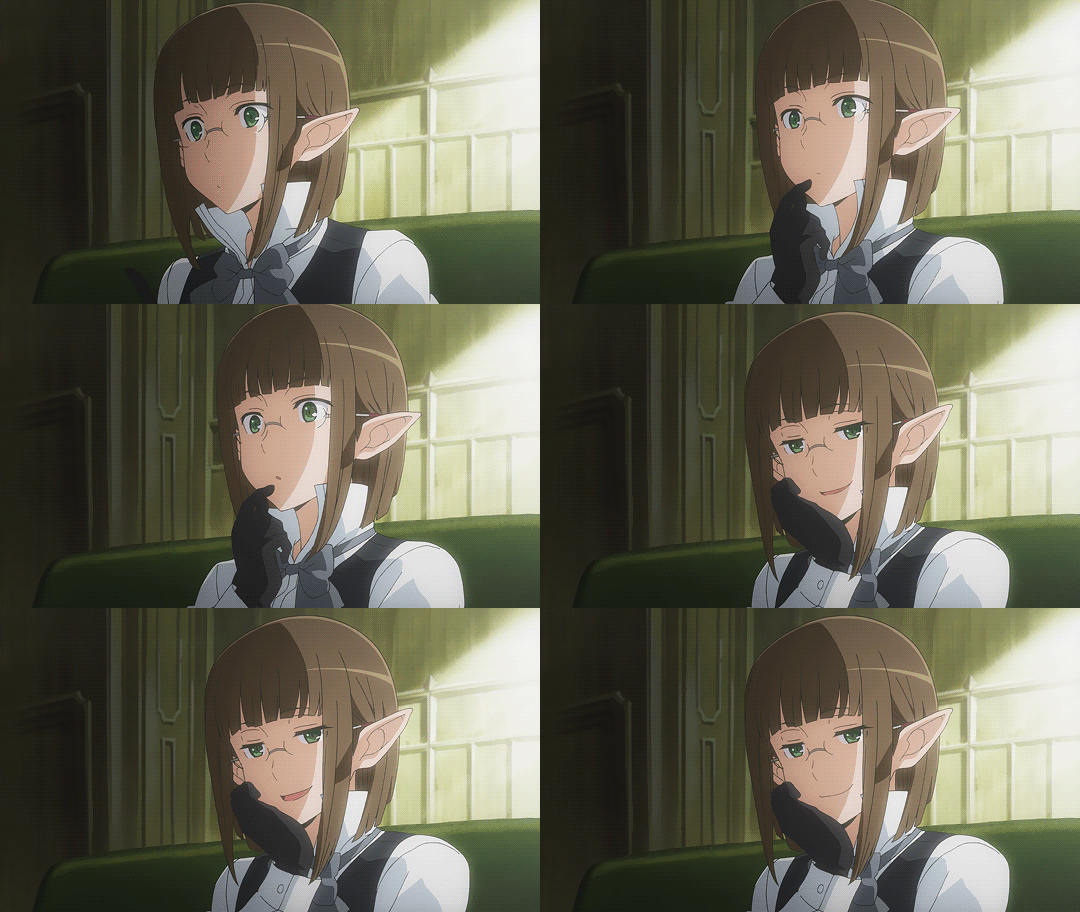
(I don't really care what they look like or what their gender is! Ideally someone who looks kind of prim and proper, but there's a lot of space within that)
The whole ship is loosely based off of a mixture of nuclear submarines and the HMS Bristol,
both of which I have been on (neither of which while underway). Unlike either, however, food does not consist of just baked beans, cheap sweets, and old potatoes within a few weeks.
Any unmentioned stuff is probably stuff from either nuclear submarines or the HMS Bristol, and expect some of that.
...I may have gone a little overboard here, sorry for that if it's an issue, including the pun. I'm never going to have any issues with not having been specific enough. And this is the edited-down version.
Name
The USS Melqart is named after the Phoenician god of travellers and rebirth. Melqart was also a god of the sea, hunting, fertility and colonisation. He was said to have found a dye that allowed Phoenicians to create purple cloth, and high profits.
To the crew of the USS Melqart, this represents their role in the fleet; being a discoverer of new things, being unafraid to go to new places to live, and being highly productive.
Most of the crew call the ship the Melqart for short, and affectionately call it the Milk Heart. The British crew members take this further by calling it the Heart of Milk as a loose reference to the works of Douglas Adams. New British recruits who use this name are often disappointed by the lack of an Infinite Improbability Drive. The Chief Engineer is working on it (or will be when I have one).
Appearance (internal and external)
The Melqart is a small ship- by Star-Ship standards. Unlike many ships, the Melqart is a fairly consistent width all across it. It's designed aerodynamically, and is fairly thin and long, much like a Terran battleship. The Melqart has no right angles, so as not to be detected by RADAR, on its exterior. The Melqart is a dark purple-blue colour, to blend in with space.
Inside, the Melqart has a large military training area, with "sectors" in closed off chambers, so that all crew members can learn how to cope in various environments if they become stranded, and so that military staff can learn to master stealth. It's become a tradition for there to be various war games, largely between military staff, but the whole crew are allowed extra training sessions, which many chose to take up, for the war games. There are informal competitions in the war games, where tournaments can go on for months.
There is a seed bank, where batches from (mostly plant-like) species encountered are kept. The science crew use some of these seeds for medical research, and some for food research (and eventually for medicine and food), but most go to long term storage.
Due to maintaining absolute stealth, the Melqart has hydroponics, and full oxygen and water recycling. It's can last several months without outside contact and minimal warning. Children often help with the hydroponics recreationally, and as a means of contributing to the ship.
The Melqart is fitted with a vast array of surveillance equipment, most embedded inside with just small bits visible from outside. During times where combat is expected, the accomodation becomes hot-bunked, so only the rooms closest to the workstations are used, to cut down extra minutes of walking between. This also happens if the ship gets over-crowded.
Because of the length, many parts of the ship have accomodation on the deck below the place where their inhabitants work, to minimise walking time. The Melqart is double-hulled; for sound-insulation, to reduce damage during pursuits, and damage during battles, so that crew members remain safe.
There are metal pipes and bars sticking out through much of the ship, mainly in accomodation areas, as she was not made for comfort. In areas more prone to fires, there are bulk-head doors, which can be identified in that there is a large, thin metal sheet along the floor, one attached to the ceiling, and one to each side of the door, so an air-tight seal is formed. Luckily this mostly only includes large mechanical systems, and there are still routes out for disabled workers during fires. Still, it's not great for people unaware of them, and therefore the need to pick feet up high to avoid stubbing toes.
Role
The Melqart is a research vessel- both of original science to help the federation and, in times of unrest, of weaponry and defenses of the opposing side, so that correctly selected ships can take over. However, the Melqart is already fairly heavily armed.
In most uneasy situations, the Melqart dims the lights, switches to silent, and moves in slowly, to go undetected. The Melqart stays in position, or very slowly travels, trying to get as much information as possible. This role means that during hostility, they have to entirely cut off non-encrypted communication- in fact, they come up with unique codes and encryptions before each surveillance period. During long surveillance periods, they'll agree to change the encryption periodically.
The Melqart frequently changes who they work with, and can often just prioritise who most benefits them. They rarely make individual, formal alliances, but neither do they normally make formal enemies. If they don't see an advantage to making an ally or enemy, they won't.
During peacetime, the Melqart tends to stick quite close to individual planets, researching on it. They often spend a lot of time investigating new civilisations.
Crew
The crew has a surprisingly large demographic of aliens compared to many others. Different cultures and religions are welcomed and celebrated aboard, and all accommodation areas have a special area for 'non-specific religious practice', which is a large part of what makes the Melqart appealing to alien and non-US crew- if surveillance is their thing.
All staff are trained in combat and survival skills, and children are taught even from a young age in survival skills. Children are raised to be perfectly happy exploring at the expense of comfort, or even to have an enormous sense of adventure.
The Melqart has very few luxuries aboard, and has pipes and metal edges sticking out at weird angles, so the crew come to be very spatially aware, which is actually an enormous bonus during space combat or combat through unfamiliar places. Many are highly agile. 'The floor is made of lava' is a very popular game among the young aboard, and due to the many pipes and metal bars, most children grow to be capable of never touching the floor within their accommodation. There are a lot fewer bars in other areas, due to this being predicted.
The lack of luxuries may explain their obsession with good food, as it's the only real luxury they have.
Captain
The captain fundamentally disagrees with the prime directive so, aboard ship, it's a poorly kept secret that they often teach native peoples about things in exchange for gathering information about their own planet and civilisation. This is generally done by discussion with them, which can take a long time across the language barrier(s), and is the main reason for the length off their pauses near individual planets.
Typically the captain offers to trade knowledge on things that might help their civilisation to flourish (with their consent), for knowledge about various things, namely; their culture, their anatomy and biochemistry, the ecology of the planet, which animals and plants have potential to be used in science, etc. - or basic supplies. However, the captain has a firm line of never exchanging knowledge of weapons that could pose any threat to the federation, or knowledge of space or air travel.
The captain has similar measures against some other directives, judging by what is actually best, rather than what the directives say is best. The crew is surprisingly good at keeping this all hidden.
The captain doesn't get into unnecessary conflict. They only get the Melqart into formal alliances or hostilities willingly when there is a very clear benefit to their ship or crew. They tend to take missions in exchange for short-term rewards from other crews.
The Captain is British, and proud of it, and actually started the tradition of calling the ship the Milk Heart, (a rather well-kept secret). They have an air of slight disinterest, which is their way of keeping the crew calm.
(I don't really care what they look like or what their gender is! Ideally someone who looks kind of prim and proper, but there's a lot of space within that)
The whole ship is loosely based off of a mixture of nuclear submarines and the HMS Bristol,
both of which I have been on (neither of which while underway). Unlike either, however, food does not consist of just baked beans, cheap sweets, and old potatoes within a few weeks.
Any unmentioned stuff is probably stuff from either nuclear submarines or the HMS Bristol, and expect some of that.
-

Chamrosh - Posts: 3173
- Joined: Wed Jan 07, 2015 5:19 am
- My pets
- My items
- My wishlist
- My gallery
- My scenes
- My dressups
- Trade with me




























-

seabunny. - Posts: 835
- Joined: Wed Sep 23, 2015 8:17 am
- My pets
- My items
- My wishlist
- My gallery
- My scenes
- My dressups
- Trade with me
7 posts
• Page 1 of 1
Who is online
Users browsing this forum: alulu and 1 guest