
Forum rules
Oekaki posts must follow our Rules for the Site and Forum,
including the Oekaki Rules and Art Rules.
Having trouble using oekaki? Check out the Oekaki Guide or send in a help ticket.
Oekaki posts must follow our Rules for the Site and Forum,
including the Oekaki Rules and Art Rules.
Having trouble using oekaki? Check out the Oekaki Guide or send in a help ticket.
HAPPY YEAR OF THE HORSE by ♥ mizu

| Artist | ♥ mizu [gallery] |
| Time spent | 4 hours, 57 minutes |
| Drawing sessions | 8 |
| 102 people like this | Log in to vote for this drawing |
7 posts
• Page 1 of 1
HAPPY YEAR OF THE HORSE
 by ♥ mizu » Thu Feb 12, 2026 2:41 pm
guys... you have no freaking idea. i have been waiting for this since last year. omg. in fact, i was so freaking excited that i wanted it to be PERFECT. this is just a cover for what i actually drew lmao! i wanted my art to be higher resolution, so i actually used ibispaint. i had to draw it all with my finger! this is it:
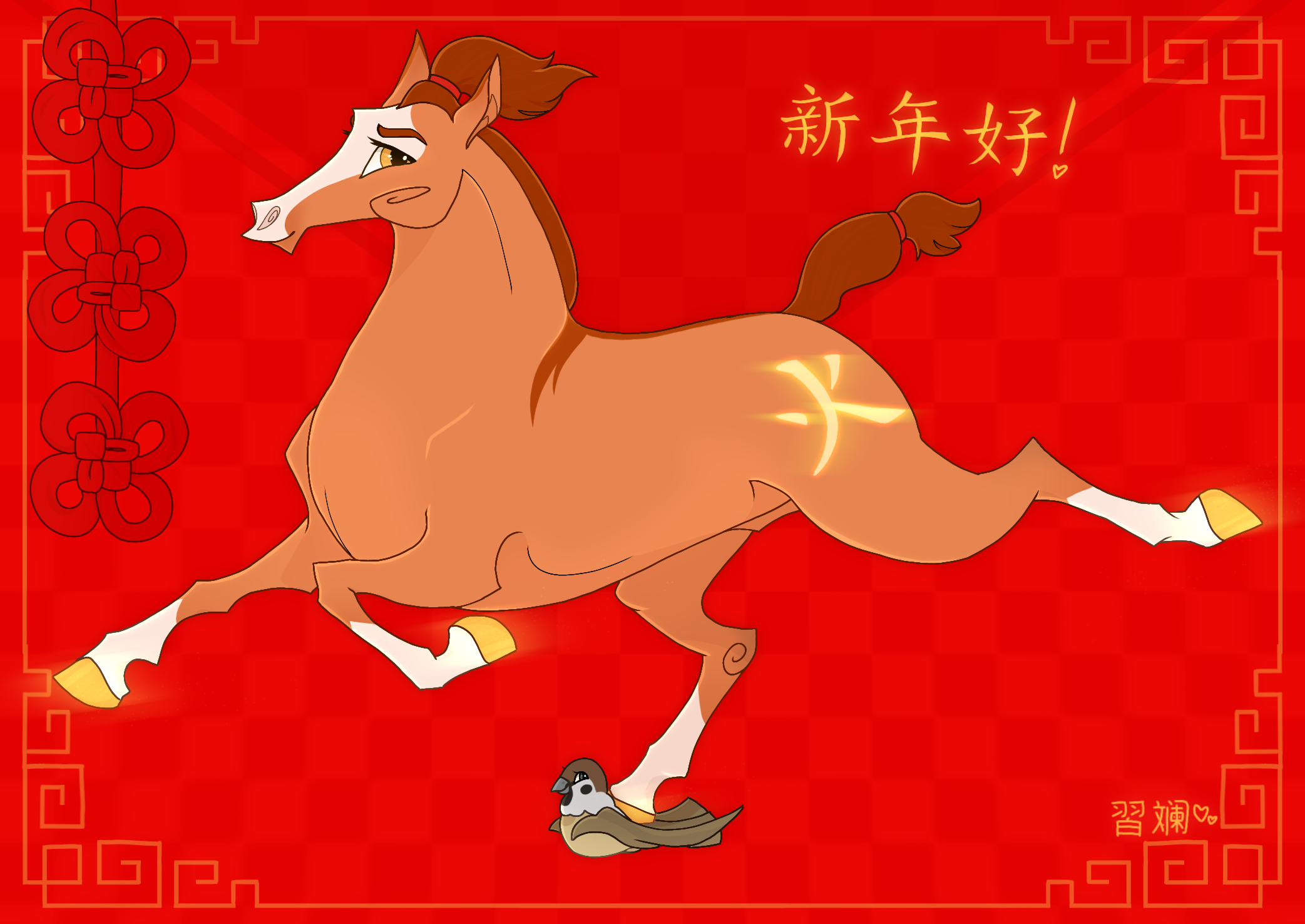
ironically, i actually think i prefer THIS drawing on cs, even though i didn't put nearly as much thought into it 😭😭😭😭 plus it's so dark looking T-T anyway. i'm going to summarize the meaning behind my "main" drawing. but for those who are interested, the letter i wrote in more detail to my friend will be pasted below!
ok now for the mother of all yappy essays
thank you for coming to my ted talk and happy lunar new year everybody
ironically, i actually think i prefer THIS drawing on cs, even though i didn't put nearly as much thought into it 😭😭😭😭 plus it's so dark looking T-T anyway. i'm going to summarize the meaning behind my "main" drawing. but for those who are interested, the letter i wrote in more detail to my friend will be pasted below!
• The Chinese zodiac was popularized during the Han dynasty, so my research was centered around that period
• It was based off of the Flying Horse of Gansu, discovered in 1969
• The Flying Horse is China's national symbol for tourism, which resonated with me because I want to go there lol
• I STRUGGLED when I tried to draw the Gansu horse in my own style, so i mimicked Mulan. Khan from Mulan is a Ferghana horse, which is the same breed as the Flying Horse
• Ferghanas ("heavenly horses") originated in the Fergana Valley in what is now Uzbekistan, Kyrgyzstan and Tajikistan. To get these horses, the Han sent a military campaign of 60,000 men and 30,000 of their own horses. After suffering a 50% loss of their troops, they returned home after acquiring just 30 Ferghanas and 3,000 horses of lower quality.
• These horses were seen as highly spiritual and reinforced the emperor's court being connected to the divine realm
• Ferghanas would've often come in the colours of chestnut, dun, bay, and other primitive yet solid coats. I chose red dun because it tied into their descriptions as well as being the perfect fire-y coat colour. Horses with a lot of white markings were seen as bad omens so I kept him relatively simple
• The Flying Horse is male and represents Yang (male) energy. If you look closely, he actually has canine teeth and male anatomy. He also has swirling patterns.
• My interpretation of it is that the swallow is his Yin. When they work together, they are able to fly through the sky and achieve new heights.
• Fun fact: the Gansu horse was unearthed in 1969, and the previous Fire Horse year was in 1966 - just 3 years before! The Chinese zodiac runs on a cycle so that there is only a Fire Horse year every 60 years, which makes this a fun coincidence!
• The knots represent strong friendship, and 3 is a lucky number in China
• also, i want to note that the signatures i used for these drawings were names that she gave me and are not in any way like my real name. and yes i do understand what they mean 👍mods they're not vulgar dw
• also translation for the mods: in THIS oekaki drawing, the text reads "新年快乐!" (Happy new year!") and "马到成功" ("May success come swiftly"). The text in the second image also reads 新年快乐
ok now for the mother of all yappy essays
I'd like to now share with you what I learned while drawing my annual greeting card. I used a new art program, and that program's timer states it took me a total of 5 hours and 48 minutes (though I'd credit at least 2 hours of that to researching in other computer tabs and fiddling with the program). Please forgive me if any of my information is inaccurate: it is difficult to find sources for a topic as niche as ancient Han Chinese horse art, but I had such a blast researching this that I figured maybe you'd wanna hear my musings, too.
The Chinese zodiac was popularized during the Han dynasty, so of course I wanted to make many references to that era. I am sure that you are familiar with the Flying Horse of Gansu (銅奔馬 or 馬踏飛燕). The Flying Horse, dated to the Han period, was discovered in 1969 and eventually became beloved worldwide after Guo Moruo (郭沫若) was struck by its beauty. It is on a 64-item list that ensures it will not leave mainland China for exhibitions, although its copies have been displayed all over the globe. What really cemented my love for it is that it is China's national symbol for tourism. I wish so badly to visit China, and it only made sense to draw inspiration from such an iconic piece. However, that is not the only connection I want to draw from the Flying Horse, but I would like to give you more context first.
The first thing I thought of was what pose I wanted to use for my drawing, and, after I figured that out, I took a pencil to paper and began doodling. However, I just… couldn't get it right. Nothing seemed to look correct, because my own art style differs so greatly from the one used for the Flying Horse. Thus, I chose to mimic Disney's Mulan. It was good practice, actually.
Unfortunately, Mulan is set in the Northern Wei dynasty, a few hundred years after the Flying Horse - but the horse Mulan rides, Khan, is a now-extinct Ferghana horse. This is where my absolute obsession with horse breeds comes in, and where I had the most fun. Ferghana horses (大宛馬), also called heavenly horses, were the most beloved horses in all of Asia during the Han dynasty. They originated in the Fergana Valley in what is now Uzbekistan, Kyrgyzstan and Tajikistan. In order to get these horses, the Han sent a military campaign of 60,000 men and 30,000 of their own horses. After suffering a 50% loss of their troops, they returned home after acquiring just 30 "heavenly horses" and 3,000 horses of lower quality. This, perhaps, was intentional: Emperor Wu of Han only wanted a few horses to satisfy his spiritual needs, and the rest were used to grow his cavalry. What I cannot emphasize enough is that these horses meant so much to the Han that thousands of men died just for the chance to get them. It was sincerely believed that these horses were otherworldly and that they reinforced the connection between the emperor's court and the divine realm.
That belief was what kept them popular for the next 1,000 years before they fell out of favour. Heartbreakingly, these horses and their successors are all now extinct, but it is hypothesized that the Akhal Teke is one of its descendents. Based on descriptions of the Ferghana horse's conformation, I personally don't believe this to be true, although I wouldn't be surprised if the Akhal Teke did share remnants of its legendary blood. Akhal Tekes share the lustrous coat and incredible stamina of Ferghanas, although there are hundreds of stories of the Akhal Teke's origins and I feel that this isn't the most believable of them. Regardless, the Flying Horse of Gansu is also based off of a Ferghana horse.
Next, I had to decide on the colour. I read and referenced an article by Amelia Sloth on Ferghanas: "Its back was marked like a tiger’s, and at peak exertion, it sweated blood, staining its body red like cinnabar, giving rise to its other name, the “blood-sweating” horse." From this, one can infer that these horses were commonly of a red (chestnut) colour, and these tiger-like markings are what we now recognise as dun (probably not brindle). This tied in PERFECTLY with the themes of fire, and so I went about making the horse a red dun with subtle markings. The Han Chinese did not like their horses to have super flashy or unusual white markings because it was seen as a bad omen.
However, I now want to tell you my favourite part about this whole thing: the Gansu Horse's symbolism. Before I even began drawing my real piece, I did a study of the Flying Horse where I analyzed everything about it: its proportions, details, expressions, etc. What makes the Flying Horse so perfect for this year is that it is deeply representative of masculinity and of Yang energy. He has male anatomy and canine teeth, which indicate he is at least four years old (an adult). His head is held high with pride as he runs at peak exertion.
Perhaps the swallow that his foot delicately rests upon is his Yin, which grounds him and keeps him stable. Working in harmony allows them to fly across the sky: the Horse would not be able to do so without his swallow. Maybe the Horse allows the swallow to experience flying anew, and this brings her a renewed sense of excitement. That's just my interpretation, anyway. The year of the horse is considered to be of Yang energy, and I felt that the forwardness of this iconic horse was utterly perfect. Another fun fact: the Gansu Horse was discovered in '69, right? There was a Fire Horse year in 1966, just three years before. Considering the Chinese zodiac runs on a 60 year cycle, I think that's an interesting coincidence.
Finally, I of course had to draw a background. I noticed that a lot of CNY artwork has a really minimal background, so I just went with a classic, patterned red with gold details. The knots (盘长结) I included are traced over the ones from last year. I didn't want to have to redraw them, they were extremely complicated to draw previously hahaha. I'd originally drawn two, but then there was a note on one of my sources that stated the numbers 2 and 3 are unlucky for the Fire Horse. The website said that four was a lucky number for the Fire Horse, and so I added two more before remembering that 4 is generally unlucky… which made me very confused. My sources contradicted each other. I switched it to just 3 instead, but please don't think too hard about the symbolism here because I'm actually really confused. I'm not trying to curse us: we aren't Fire Horses, so I think it's okay.
thank you for coming to my ted talk and happy lunar new year everybody
-

♥ mizu - Posts: 9889
- Joined: Fri May 15, 2020 9:21 am
- My pets
- My items
- My wishlist
- My gallery
- My scenes
- My dressups
- Trade with me
Re: HAPPY YEAR OF THE HORSE
by Ariana Black » Thu Feb 12, 2026 3:18 pm
stunning
Profile Picture was made by @TheNightwishmaster on Deviantart. Commissioned by me
.xiaohuli - Discord •
makaniblack's toyhouse •
.xiaohuli - Discord •
makaniblack's toyhouse •
-

Ariana Black - Posts: 28688
- Joined: Thu Feb 24, 2011 7:08 am
- My pets
- My items
- My wishlist
- My gallery
- My scenes
- My dressups
- Trade with me
Re: HAPPY YEAR OF THE HORSE
by ^RukaDog^ » Thu Feb 12, 2026 3:56 pm
Yoooo that’s actually so cool. I will admit I didn’t read the whole thing lmao, ur writing is so neat omg I could NEVER. I actually forgot how to say happy (Chinese) new year in Chinese…uhh don’t tell my Chinese teacher that. The fire on the first horses mane is LITERALLY PERFECT. And the stylisation on the bottom one is AMAZING. I. LOVE. IT.
Ruka. She/her. biggest midzy. ITZY <3
Yeji Lia Ryujin Chaeryeong Yuna
ITZY
STREAM TUNNEL VISION
proud to say I promote itzy more than JYP does
-

^RukaDog^ - Posts: 2216
- Joined: Wed Apr 17, 2024 7:07 pm
- My pets
- My items
- My wishlist
- My gallery
- My scenes
- My dressups
- Trade with me
Re: HAPPY YEAR OF THE HORSE
by Melatonins » Thu Feb 12, 2026 5:06 pm
this is amazing!! i love how much research you put into this, and i enjoyed seeing last year's post compared to this year <3 i do remember seeing that one when you posted it, i thought and still think its really cute 



















-

Melatonins - Posts: 2610
- Joined: Fri Aug 17, 2018 2:41 pm
- My pets
- My items
- My wishlist
- My gallery
- My scenes
- My dressups
- Trade with me
Re: HAPPY YEAR OF THE HORSE
by Black_saphire » Thu Feb 12, 2026 7:03 pm
it’s been awhile since i started up cs, the first thing i saw was this amazing piece?? oh my gosh bliss, this is stunning. i love love love your thought process and how much time you put into this!! i bet you get amazingggg english grades, and your chinese characters are so neat?! okay, i actually want to study Chinese history and culture now, this is so cool!!
 |
|

hi!! i go by cinder or saph.
i like to collect characters
( mostly animals)
and doodle them
sometimes!!
-

Black_saphire - Posts: 1918
- Joined: Tue Apr 16, 2024 4:18 pm
- My pets
- My items
- My wishlist
- My gallery
- My scenes
- My dressups
- Trade with me
Re: HAPPY YEAR OF THE HORSE
by p-ond » Fri Feb 13, 2026 7:15 am
this is really lovely, super lines and colours 10/10

-

p-ond - Posts: 2432
- Joined: Sat Jan 23, 2010 9:25 am
- My pets
- My items
- My wishlist
- My gallery
- My scenes
- My dressups
- Trade with me
Re: HAPPY YEAR OF THE HORSE
by meisxinyi » Fri Feb 13, 2026 11:10 am
SUPER PRETTY ART AS ALWAYS!! and I'm so happy you researched the lore behind the fire horse too, It's always fun to read about these!
█
█
█
█
█
█
█
█
█
█
█
█
█
█
█
█
█


│
│
│
│
│
│
│
│
➤│
│
│
│
│
│
│
Toyhouse
•
Deviantart
•
UMA archives
•
cloudy leopards
•
credit
-

meisxinyi - Posts: 2711
- Joined: Sat May 29, 2021 1:32 pm
- My pets
- My items
- My wishlist
- My gallery
- My scenes
- My dressups
- Trade with me
7 posts
• Page 1 of 1
Who is online
Users browsing this forum: BlueEyedKite, TheUltimateBoykisser and 0 guests